SCOTT SIMPSON & SHARLA STEEVER
Tend the human
terrain of your work.
A working companion for classrooms, staff teams, universities, organizations, and businesses. Find an idea, reflect on it, and choose a practice for your setting.
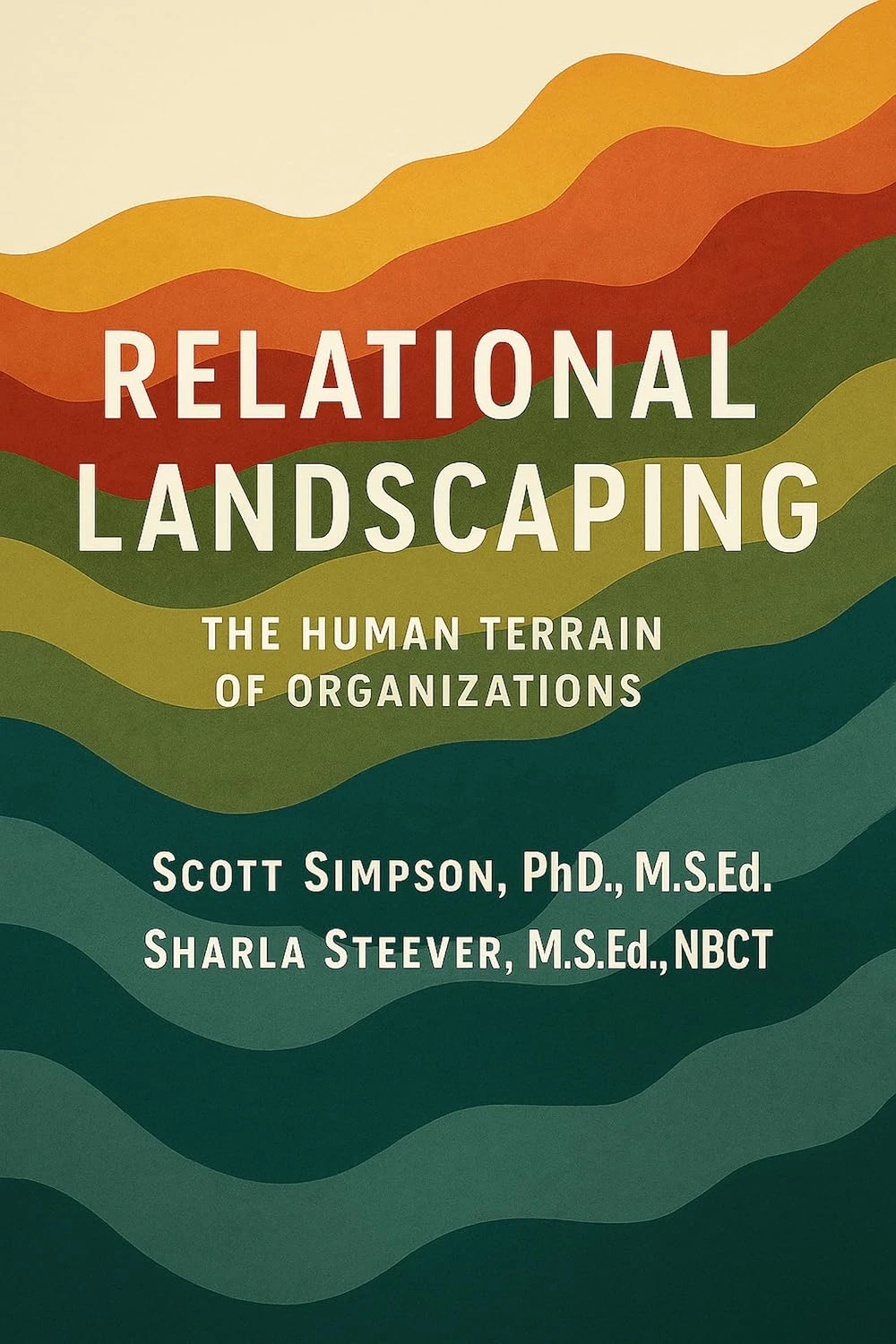
THE IDEAS, WITH ROOM TO GO DEEPER
Explore a concept
Brief introductions lead to deeper exploration,
book references, and a practice to try.
READ ALONG
A path through the book
Cultivate everyday relationships, or explore
restructuring, transitions, mergers, and culture.
MAKE IT CONCRETE
One place to begin
Companion activities adapted from the book’s ideas.
Choose your setting, then a need.
A 30-minute reflective experience
Companion adaptation · Based on Chapters 3, 7 & 9
- 0–4 minutes: arrive. Explain the purpose, invite participation, and name the option to pass. Agree how personal stories will be held.
- 4–8 minutes: a shared third thing. Read a short selected text twice. Invite a word or phrase that stands out, without requiring explanation.
- 8–15 minutes: reflect privately. Write, think, or quietly attend to what the text brings to mind. Offer one open question.
- 15–25 minutes: pairs. Give each person equal time. Listen without unsolicited advice; silence is welcome. Sharing remains optional.
- 25–30 minutes: return and close. Invite one personal insight or next step. Close the reflective space explicitly before other business.
Use a text appropriate to the group and retain its source and context. This is a reflective adaptation; the Circle of Trust® approach is a specific practice with its own facilitator preparation.
PAUSE. WRITE. LISTEN.
Questions for deeper inquiry
Reflection prompts from the book for private writing
or voluntary conversation.
Original book wording, with spacing and line breaks normalized. Use these questions for private journaling or voluntary discussion. This site does not collect journal responses.
READ TOGETHER. PRACTICE TOGETHER.
A rhythm for your book study
Before you meet
Choose a chapter or concept. Read the named passage in your book and select one reflection prompt. Give participants time to journal privately.
When you gather
Invite a word, question, or insight. Allow passing. Listen without fixing, and leave room for different experiences of the same idea.
Choose an experiment
Open the chapter’s implementation invitation. Choose a manageable practice, decide who will support it, and set a date to revisit what happened.
Return and learn
Ask what changed, whose experience you heard, and what needs adjustment. Use that learning to choose the next chapter or practice.
Companion book-study adaptation. The book’s chapter poems can serve as shared “third things” for inquiry.
KEEP THE CONVERSATION GOING
Contact Scott & Sharla
Get in touch about the book, a book study,
or applying Relational Landscaping in your setting.